Updated 22 September 2026 (evening). A scripted UR5 + RG2 expert picks hollow PLA tubes out of a free 16 g Hazel box and sorts red tubes left and blue tubes right. This update rewrites the expert: tubes are now only ever grasped across their axis, like picking a pen off a desk, and every reach and every carry is a single smooth curve with the wrist turning on the way.
Result of this recording: 7/16 tubes sorted across 4 four-tube episodes within 90 s each; 0/4 episodes fully sorted; 3/4 pass the physical-validity gate (robot penetration ≤ 3 mm, box contacts ≤ 0.8 mm, tube contacts ≤ 1.5 mm, no unintended robot–box contact); 0/4 fully sorted and valid. The previous recording on this scene (morning of the same day) sorted 2/8 tubes with 0/2 episodes fully sorted. This is a development recording, not a reliability benchmark.
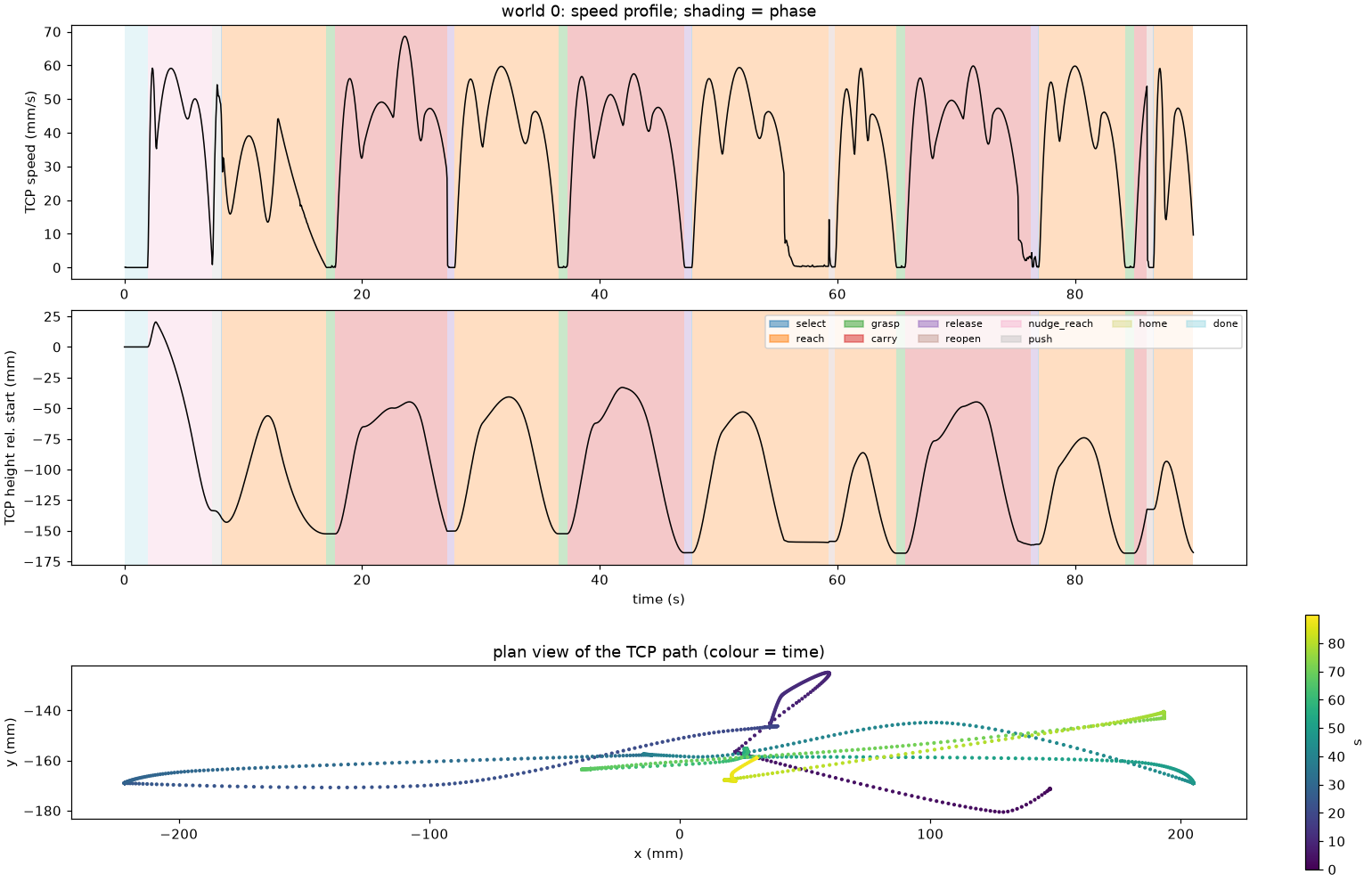
A reach is one cubic Hermite curve through four knots: leave the previous spot on a rising curve, swing over the chosen tube while the wrist turns to the grasp yaw, and decelerate down a short vertical final approach. A carry is one curve through five knots: up out of the pile leaning toward the destination, an arc over to the target box while the tube is turned to lie along it, and a vertical lowering onto the support. Via points, arc heights and pace are jittered per stroke so the demonstrations are smoothly random rather than deterministic or jerky (the demonstration recipe argued for in the behavioural-cloning-mystery post). The stroke is slowed until its fastest point stays under the servo's 60 mm/s and the wrist turn stays under the 1°/step action limit.
TCP speed, height and plan view of one world (colour bands are expert phases). Measured tracking error while moving: mean 1.8 mm, 95th percentile 10.4 mm.
Motion statistic (one world)
Previous expert
This expert
Peak TCP speed
75 mm/s
69 mm/s
95th-percentile acceleration
0.36 m/s²
0.07 m/s²
Largest acceleration
1.43 m/s²
1.03 m/s²
Steps with a speed jump over 20 mm/s
4%
0%
Steps with a saturated position command
29%
5%
Grasp selection in a pile
Every tube is scored at seven grasp points along its length (centre, ±12, ±24 and ±30 mm). A point is feasible when the measured finger envelope descending there stays inside the box walls, touches no other tube whose top reaches it, and nothing rests on the tube. The expert takes the highest feasible tube (top of the heap first), preferring the nearest one and a balanced centre grasp, with a little jitter for diversity. End-on grasps were removed: an 80 mm tube plus the finger thickness needs 120 mm of clear width and the box interior is 94 mm, so an end grasp inside the box clamps the walls and lifts the box.
A tube crowded by a wall or a parallel neighbour has no feasible point. It is then rolled into free floor: the shut pads press on its crown and drag it across its axis away from the nearest obstacle, and selection runs again. After three nudges a tube crowded only by neighbours is still attempted; one that is still against a wall is left. A grasp is verified part-way up the lift (the tube must rise with the pads and both pads must touch it); a miss reopens and re-plans, and the remaining knots of a carry are re-aimed for where the tube actually sits in the hand.
What is still open
[0, 3, 4, 4] tube(s) were abandoned and [2, 0, 1, 6] recoveries occurred in the two diagnostic worlds. The remaining failures are tubes that stay crowded after nudging, and the free box springing up a few millimetres whenever a tube's weight leaves it (a real effect of the soft box–table contact, no longer treated as the box being lifted). The ACT student has not been retrained on these demonstrations. Previous page · Diagnostic report