Three models. Two phones. The same lab.
MapAnything, Depth Anything 3, and VGGT-Omega reconstruct two complete phone recordings, using 128 shared keyframes per capture. Explore their colored point clouds, inspect individual views, and compare the predicted camera paths.
Measured runs
All three process the same images in one joint reconstruction, using their official preprocessing and pretrained weights. No camera calibration, poses, depth, or per-scene training is supplied.
| Model | Input size | Inference | Load + preparation | Peak GPU memory | Camera path disagreement* |
|---|
Inference uses one A100; model downloads and cloud export are excluded. The DA3 API’s inference timing also includes image preprocessing and CPU output conversion.
The full recording, sampled for speed
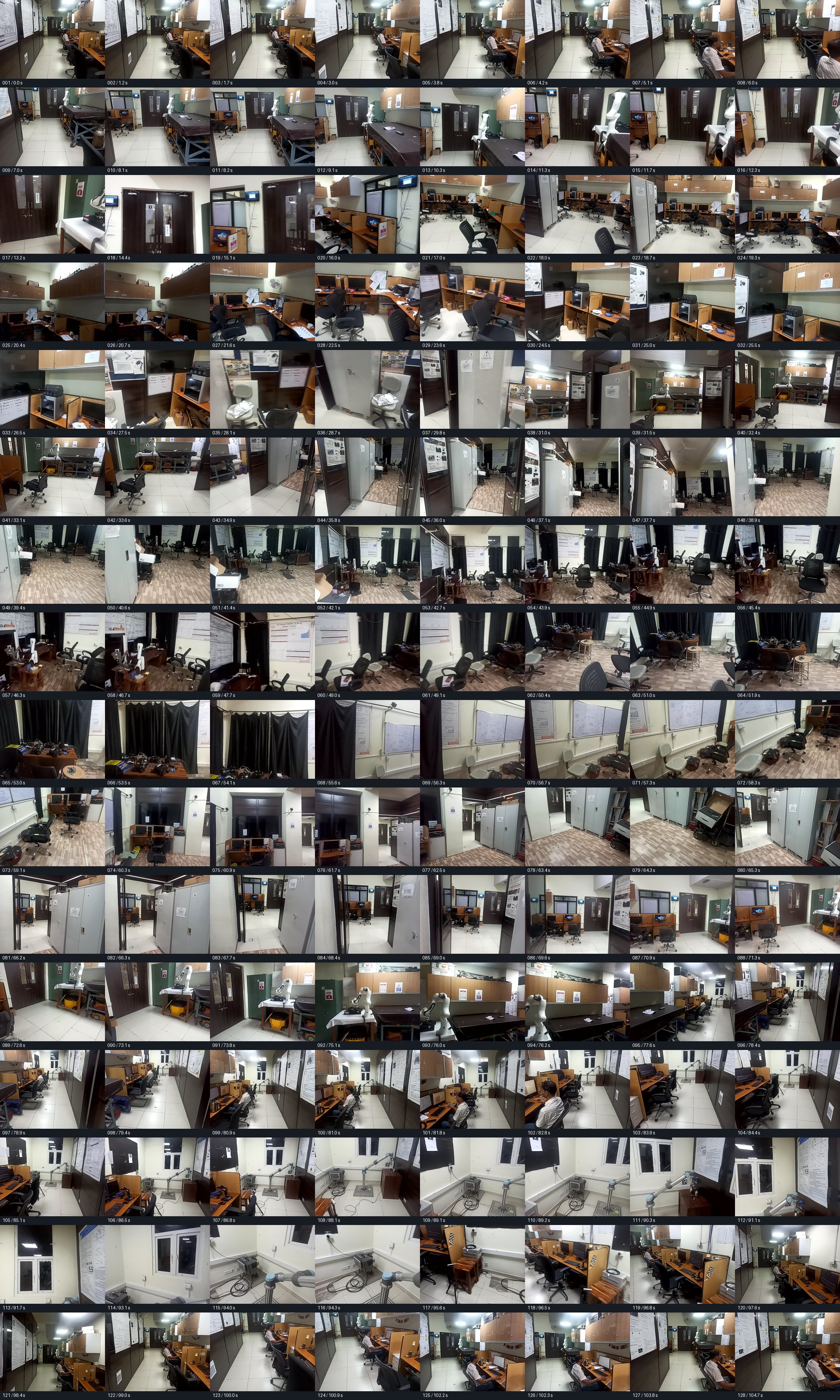
Frame names, original indices, and timestamps ↗ · First capture and trained splat ↗ · Earlier ReSplat experiment ↗
How to read these clouds
Geometry, color, and coverage
These are colored depth points, not Gaussian splats or finished meshes. Holes, doubled surfaces, drifting paths, and floating points are model outputs. Try the top view to inspect layout, then visit capture cameras to inspect local detail.
Display filtering
All clouds use finite positive depth and the same 3% depth-edge filter. We sample at most 12,000 points per view for the browser. MapAnything also supplies a native validity mask. The confidence slider initially hides the lowest 20% within each view; PLY downloads use this default filter.
Scale and alignment
MapAnything and nested DA3 predict metric scale; VGGT-Omega has relative scale. The first capture uses its existing SfM path as the display reference. The second uses MapAnything’s path because no SfM exists yet. Download native clouds to inspect original scale. Neither reference is ground truth.
Models and reproducibility
VGGT-Omega uses the 512-pixel checkpoint recommended by its authors for in-the-wild applications. This lab trial is not a benchmark against the paper’s reported results. Checkpoint IDs, source revisions, preprocessing, timings, and alignment transforms are recorded per run.
Commands and environment notes ↗ · Comparison manifest ↗ · Environment ↗ · Inference script ↗