The bottle stays at least 15.3 cm above the floor during the hold. Opening the fingers returns it to ground support.
Watch the full sequence ↓State-only policy learning
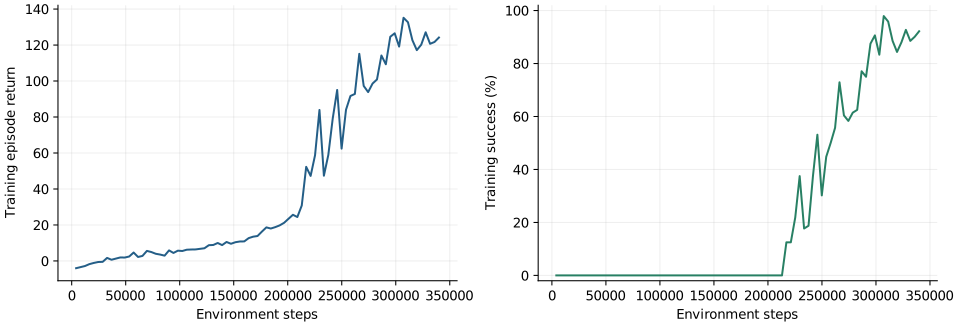
SuperDex PPO training
Stopped · 339,968 environment steps · 16 physics workers · Ray/RLlib PPO on SuperDex Lab
The policy observes 43 state values and no images. It chooses XYZ movement and gripper opening; IK tracks a fixed downward wrist orientation. Every episode starts with an open gripper above a grounded bottle. These runs use learned policy actions, with no scripted pick sequence or demonstration initialization.
Checkpoint 80: 8/8 successful development episodes. Success requires the bottle bottom above 10 cm for one second, supported by both fingers with no floor support. Repeated development seeds are not a held-out qualification set.
Both-finger contact occurred in 8/8 episodes. Contact alone does not count as a successful lift.
Evaluation records and criteria
Untrained policy
Checkpoint 70 · learned PPO policy
Fresh-seed evaluation · checkpoint 70
32/32 successful picks (100.0%). These seeds were excluded from training and repeated development evaluations. Bottle XY varies by ±1 cm; initial gripper XY varies by ±5 mm. This measures this simulated setup only.
Every evaluation outcome · Checkpoint and evaluation settings
Learned policy · fresh seed 2001
Learned policy · fresh seed 2002
Earlier RL attempts
ppo_v1_seed42 / eval_00050
This is a timestamped publication snapshot. The training process can advance between publications. The scripted physics demonstrations below remain a separate reference.
01 / Independent simulation engine
SuperDex
A contact-driven approach, grasp, lift, hold, and release. The video renders the actual recorded physics transforms with the copied YAM and bottle meshes.
15.3–15.5 cmLowest bottle mesh point during hold
2 secondsHold before opening the fingers
0.7848 NGround support after release; matches weight
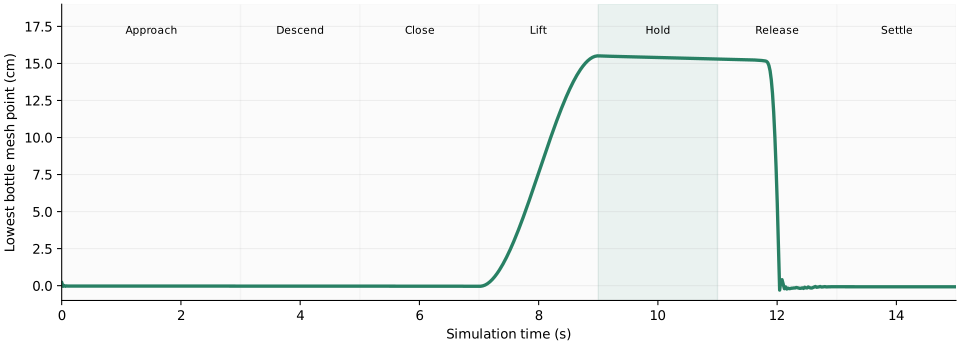
This nominal scripted pick demonstrates feasibility. It does not show that the previous RL failure is fixed, establish a success rate, or reproduce the original controller exactly.
02 / Contact solver comparison
ComFree
ComFree settles the bottle correctly, but the tested settings fail to lift it. The passing CPU reference below uses the same local scene and scripted motion with explicit arm gravity compensation.
ComFree GPU · failed pick
MuJoCo CPU · passing reference
| Backend / setting | Pick | Minimum hold height | Max coupling error | Trace |
|---|---|---|---|---|
| ComFree · default / CCD35 | Fail | 4.92 cm | 8.97 mm | CSV |
| ComFree · default / CCD100 | Fail | 4.92 cm | 9.05 mm | CSV |
| ComFree · tuned / CCD100 | Fail | 4.93 cm | 5.31 mm | CSV |
| MJWarp GPU · CCD100 | Pass | 14.56 cm | 0.36 mm | CSV |
| MuJoCo CPU · reference | Pass | 14.60 cm | 0.36 mm | CSV |
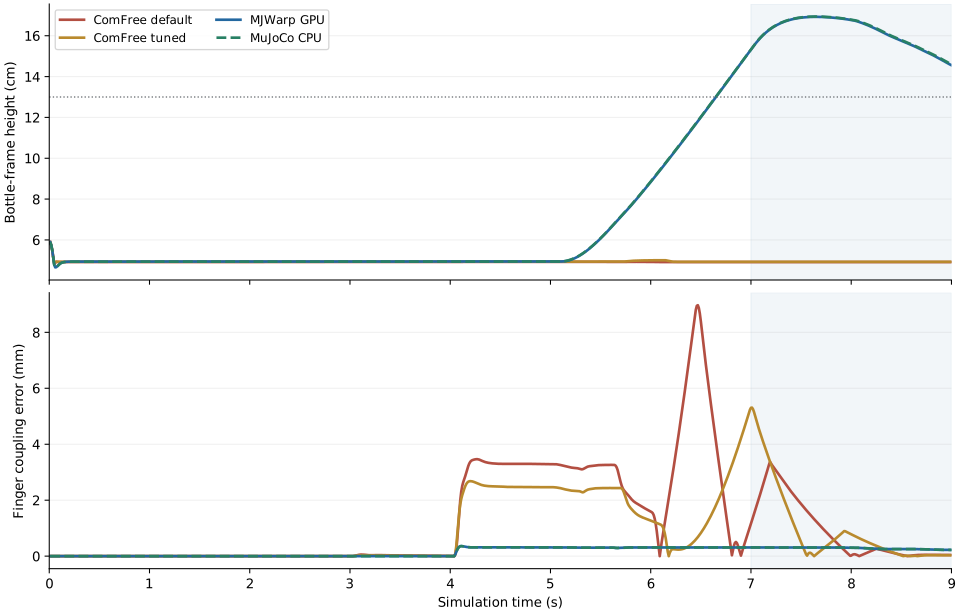
The vendored MJWarp GPU solver also passes with CCD100. Increasing ComFree's CCD budget or modestly tuning its contact parameters does not rescue the pick. Its finger coupling deviates by up to 9.05 mm, versus 0.36 mm with MJWarp. This is a measured difference to investigate; it is not a proven cause.
CCD warnings occur in both the failing ComFree and passing MJWarp runs, so the warnings alone do not explain the outcome. ComFree uses MJWarp collision detection, including convex-hull collision for this bottle mesh.
Scope and interpretation
What is shared, and what differs?
Shared starting assets
The YAM arm and the 80 g bottle come from local copies of the existing task assets. Joining duplicated texture-seam vertices produces a watertight 386-vertex, 768-triangle bottle. Each simulator owns its environment, assets, scripts, and results.
The physics probes use scripted motion. The separate PPO experiment above uses state-only learned actions. No room reconstruction or 3DGS rendering is used.
Separate feasibility tests
SuperDex uses an SDF of the actual bottle surface, tessellated wrist/finger colliders, and two symmetric finger drives with explicit PD gains. ComFree uses MuJoCo/Warp convex mesh collision, the original finger equality coupling, and arm gravity compensation.
The motion, timestep, and height metrics differ between these two setups. Read the ComFree solver comparison within its own experiment; do not rank engines by these lift heights.
Project SuperDex sourceComFree documentationComFree sourceSuperDex asset provenanceOriginal RL experiments
Earlier development runs and additional replay
SuperDex · hold-only success
SuperDex · incorrect gripper mapping
MuJoCo CPU · without gravity compensation
Discarded and unresolved probes
The first SuperDex rest probe used an incorrectly packed inertia tensor and produced a singular solver. It was invalidated and is excluded from the successful evidence.
ComFree required a local one-line fix for an undefined sensor-frame variable during Warp compilation. The patch and the data-transfer workaround are documented in the experiment notes.